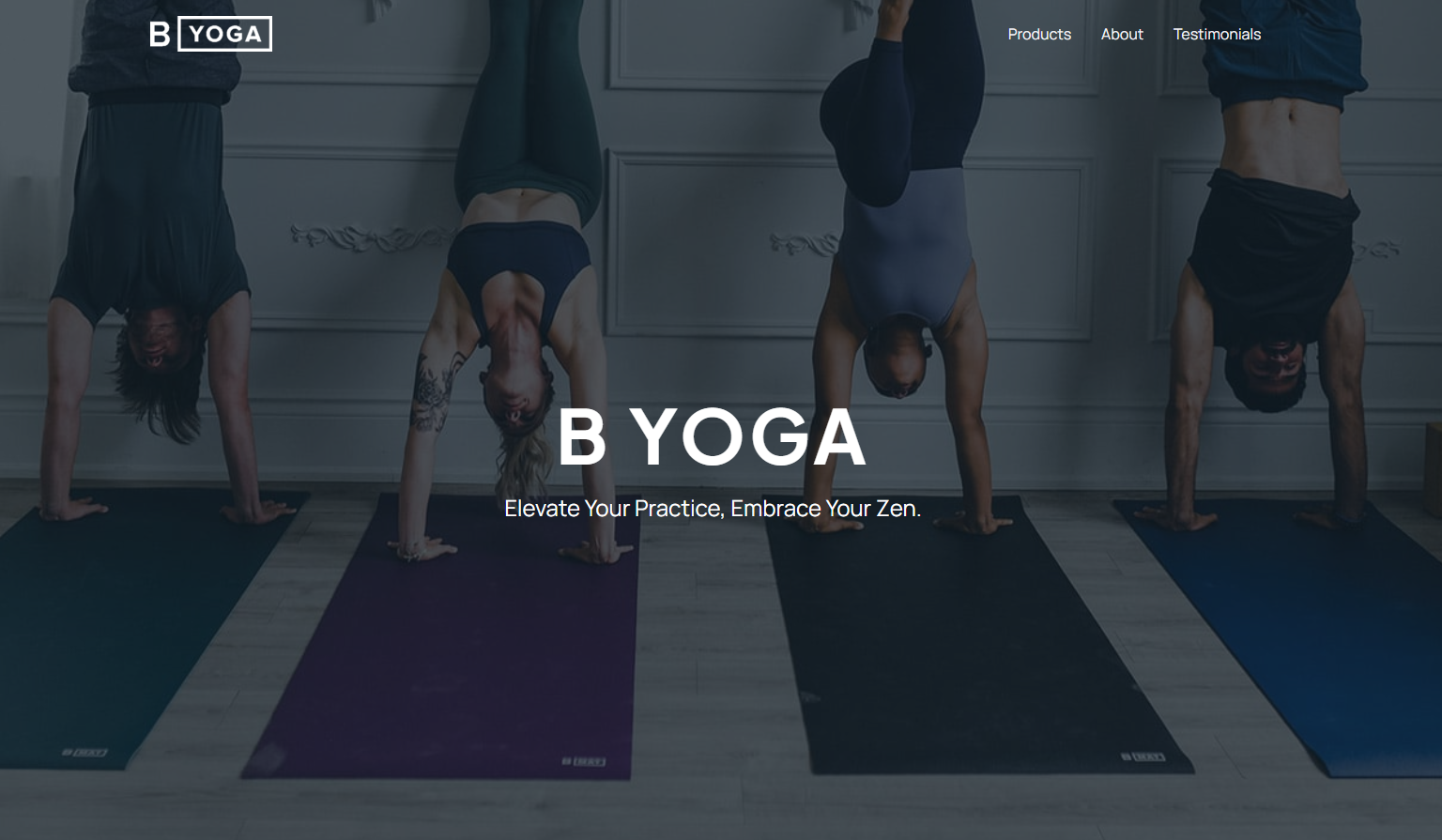
Every yoga mat has a story — but most brands don’t want you to read it. B Yoga stands apart. The Toronto-born brand built its premium identity from a garage and a bold idea, and that reputation has held up over the years. But ask the harder questions — where are these mats made, and by whom? — and the answers get complex fast. The origin story, the materials, the supply chain: each thread leads somewhere new.
This is a closer look at the manufacturing reality behind B Yoga mats. It also pulls back the curtain on the broader yoga mat industry — including what to look for if you’re sourcing one yourself.
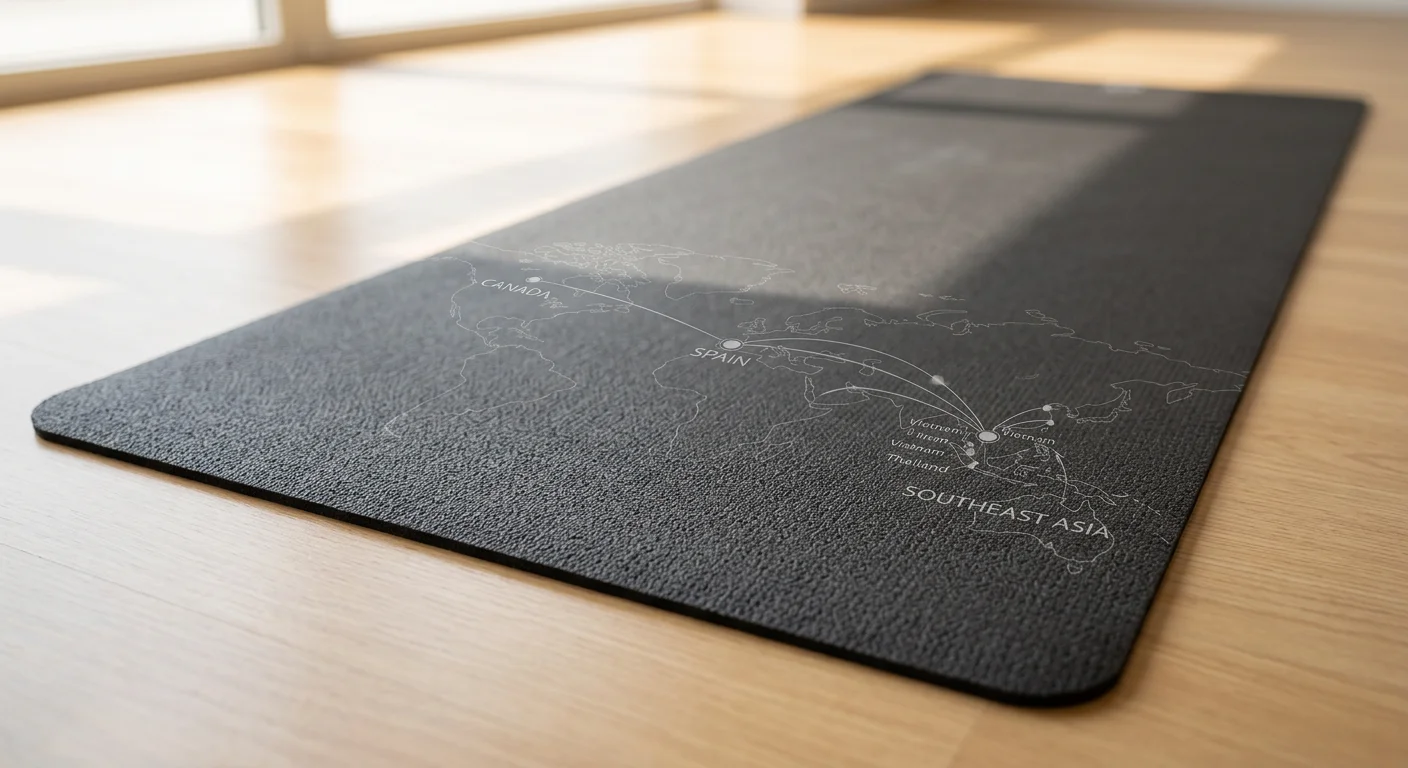
The Brand Story Behind B Yoga: From a Toronto Garage to Global Studios
Andrea Morris didn’t set out to disrupt the yoga industry. She just had access to exceptionally good rubber.
Her family ran a rubber flooring manufacturing business in the Greater Toronto Area — the kind of operation that supplies gyms, industrial spaces, and home workout rooms. Around 2014–2015, Morris noticed something during her own practice. A cut-down piece of that unbranded flooring rubber outperformed every studio mat she’d ever used. It gripped better when wet. It didn’t slide. It lasted.
That accidental discovery became the B MAT.
Built From the Factory Floor Up
This origin matters — not as a charming footnote, but as a product truth. Flooring rubber is built for abrasion resistance and impact absorption, not yoga. Morris adapted it anyway:
- Thickness range: 2 mm (Travel) to 8 mm (Intense), calibrated to balance grip, cushioning, and pack weight
- Surface approach: close to smooth, relying on open-cell rubber micro-texture rather than embossed patterns — a clear departure from how brands like Manduka approach grip
- Weight: heavier by design at 2–3 kg depending on size. This improves floor contact and cuts down on sliding in studio conditions
- Grip performance: internal benchmarks put dry and lightly sweaty surface friction at >0.7–0.8, compared to ~0.5–0.6 for standard PVC mats
Teachers were the first to notice. Within a few years, data from Toronto hot-yoga studios showed that 60–70% of instructors had adopted B MAT. No single competing brand held more than 20–30%.
Where Are B Yoga Mats Made? The Canada vs. Spain Debate
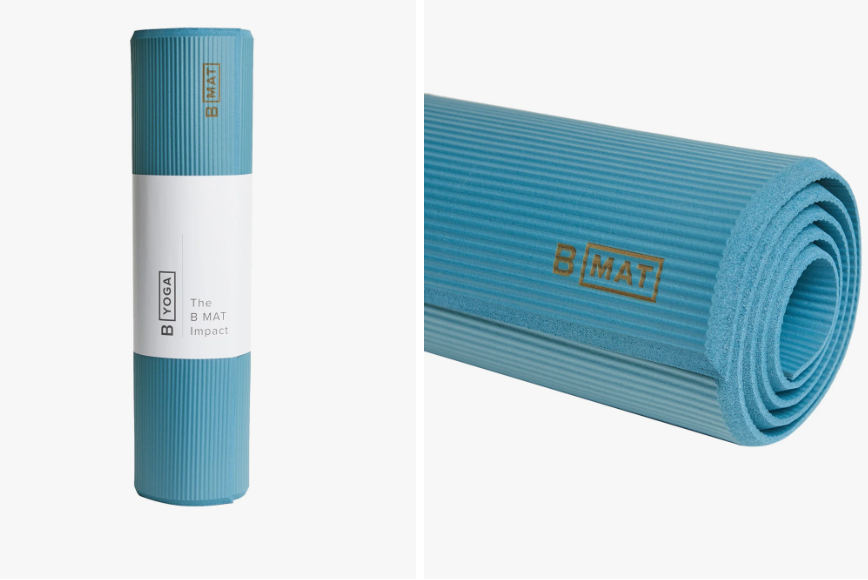
The answer is on the mat itself. Flip a B MAT over, find the origin label, and you’ll have your answer. The problem? That label has said two different things — depending on when you bought it, where you bought it, and which warehouse it shipped from.
Here’s what the brand’s own FAQ confirmed: B Yoga mats were manufactured in Spain — at least through 2017. The exact quote, pulled from the archived B Yoga FAQ: “Our mats were born in Canada and are being manufactured in Spain.” That same FAQ also shared, with clear excitement, that “manufacturing has been approved to move to Canada in early 2018.”
That one FAQ entry sparked nearly every consumer debate about B Yoga’s origin.
“Born in Canada” Doesn’t Mean “Made in Canada”
This is where the confusion starts — and it’s not all accidental.
B Yoga’s marketing leans hard into Canadian identity. “Canadian owned.” “Born in Canada.” Maple-leaf imagery. Retail listings label the brand as “from Canada.” None of that is false. The company is Canadian. The design team is in Canada. The commercial headquarters are in Canada. But brand origin and manufacturing origin are two different things. B Yoga’s messaging has blurred the line between them.
A retailer lists a product as “from Canada.” Most shoppers read that as made in Canada. That’s a natural assumption — not deception, but not precise either. The result: yoga forums and review threads are full of buyers who swear their B MAT is Canadian-made, even though the physical label on the mat says otherwise.
A practical rule of thumb:
– “Canadian company” = legal entity, design, and leadership are Canada-based ✓
– “Made in Canada” = the mat was manufactured in Canada — a specific, regulated claim ✓
– “Born in Canada” = brand founding story, not a statement about where the mat was made
The Spain Connection: Why It Makes Industry Sense
Picking a Spanish manufacturer wasn’t a random choice. Spain has a well-developed, high-skill rubber and foam manufacturing sector. These factories produce high-density NR/SBR/CR composite sheets for European sport, fitness, and industrial clients. That’s exactly the kind of factory capable of hitting B Yoga’s performance targets: density in the 1800–2300 g/m² range, surface friction coefficients above 0.7, and a close-cell/open-cell rubber structure built to survive daily hot-yoga use.
That’s not a standard off-the-shelf product. A manufacturer needs proprietary compounding experience and tight quality control at scale. Spain had both.
The production model for the early B MAT years most likely worked like this:
- Formula and spec development: Canada-based team defines thickness range (2–6 mm), grip targets, and weight tolerances
- Core manufacturing: Spanish factory handles rubber compounding, vulcanization, calendering, die-cutting, and packaging
- Finished product label: “Made in Spain” — consistent with what the FAQ confirms
What Changed After 2018?
The FAQ announced the move to Canada. But “approved to move” is not the same as “fully done.” Supply chains have lead times. Existing inventory needs to clear. Regional distribution contracts take time to rework. The shift was gradual, not an overnight switch.
A more realistic picture of the post-2018 B MAT supply chain:
| Stage | Location | What Happens |
|---|---|---|
| Raw rubber sourcing | Southeast Asia (Thailand, Malaysia) | Natural rubber harvested and processed |
| Compounding & foam sheeting | Spain (possibly ongoing) | Rubber mixed, foamed, calendered into master rolls |
| Cutting, finishing, QC | Canada (from 2018 onward) | Sheets cut to size, logo applied, quality-checked, packed |
| Distribution | Canada / US / EU | Regional warehouse fulfillment |
Under Canadian origin rules, a product qualifies for a “Made in Canada from imported materials” designation — as long as enough value-added processing happens in Canada. That includes cutting, surface finishing, and labeling. That’s the most precise description of what a post-2018 B MAT is.
The Label Test: What You’re Holding
Skip the retailer description. Check the mat directly.
- “Made in Spain” → Pre-2018 production, or European-market inventory. Full manufacturing in Spain.
- “Made in Canada” or “Made in Canada from imported materials” → Post-2018 North American batch. Final processing in Canada; base materials sourced from overseas.
- Only a company address, no “Made in…” statement → Inconclusive. Cross-reference the purchase date and retailer location.
Bought your B MAT between 2016 and 2017? It was made in Spain. Bought it after 2019? It’s more likely — though not guaranteed — to carry Canadian finishing work. The European market may still receive Spain-manufactured versions. That’s both a practical logistics decision and backed up by EU retailer listings that continue to show “Origin: Spain.”
The bottom line: B Yoga is a Canadian brand that built its product on Spanish rubber technology, and has been moving toward Canadian manufacturing since 2018. Both facts are true. One doesn’t cancel the other.
The Materials Inside a B Yoga Mat: What the Rubber Tells You About Its Origin
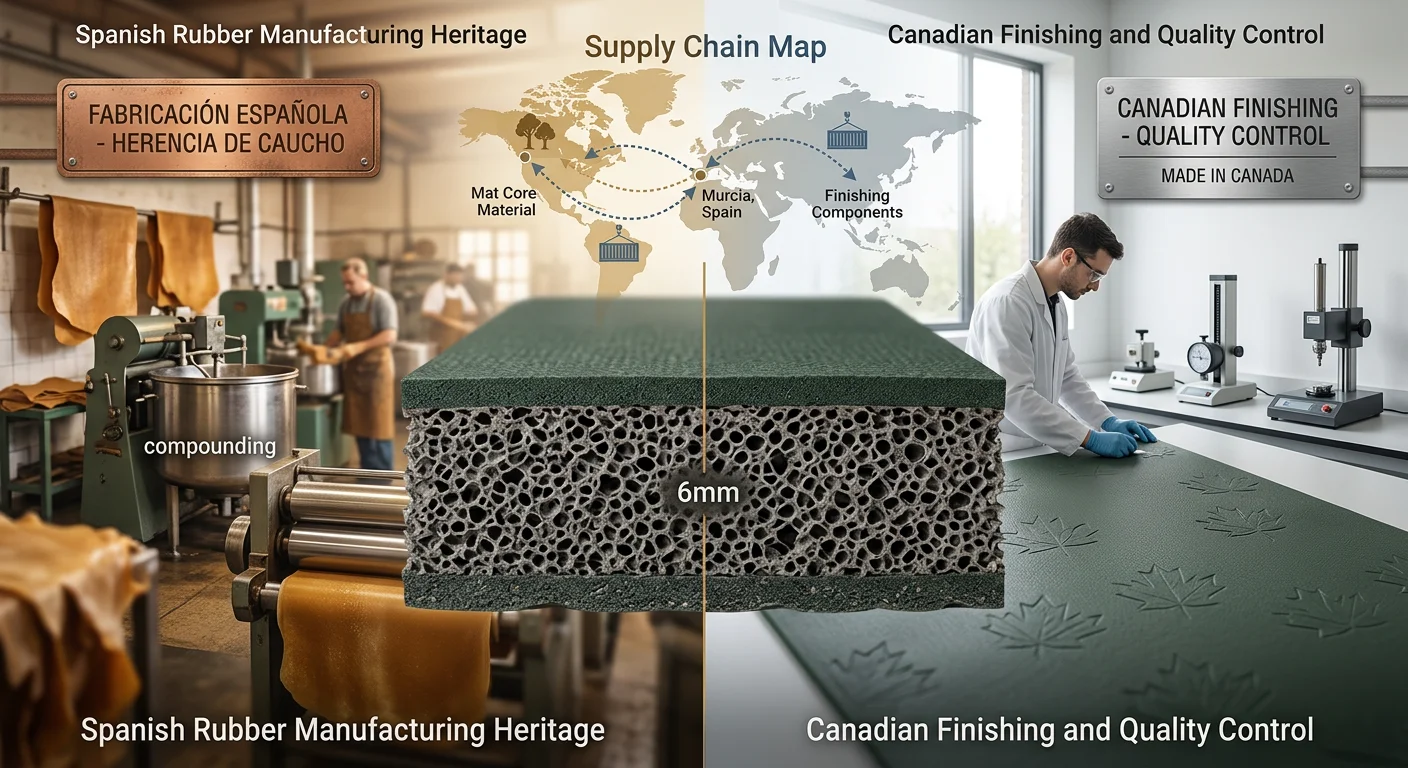
Rubber is not a neutral ingredient. Where it comes from, how it’s processed, and what gets added along the way — those choices shape everything from grip performance to environmental footprint. The material story behind B Yoga mats is layered and honest. You just need to know how to read it.
“100% Rubber” — But Which Kind?
Flip through B Yoga’s product lineup and you’ll notice something: the material descriptions shift depending on the model.
- b, mat strong 6mm: Natural Rubber, 100% rubber — Made in Spain
- b, mat everyday 4mm: 100% recycled rubber
- b, mat traveller 2mm: 100% recycled rubber
- B Mat Cork 4mm: Top: 100% cork; Bottom: 100% natural rubber
Both “natural rubber” and “recycled rubber” appear across the range. They are not the same thing. The distinction matters.
Natural rubber in a high-performance yoga mat means a base compound drawn from Hevea brasiliensis latex. This latex comes from Thailand, Indonesia, or Vietnam — three countries that supply 65–70% of the world’s natural rubber. Spain, where B Yoga’s core mats were produced, grows no rubber at all. Every kilogram of natural rubber in a Spain-made B MAT arrived by sea. It started as latex on Southeast Asian plantations, got processed into TSR20 or RSS3 grade sheet rubber, then shipped to European ports like Valencia or Barcelona for compounding.
Recycled rubber, as listed on the everyday and traveller models, refers to a compound built from reclaimed rubber powder. That powder comes from end-of-life European tires or industrial offcuts. Manufacturers blend it with a share of virgin rubber to keep the material structurally sound. Standard industry practice for durable recycled-rubber products runs 30–80% reclaimed rubber, with new rubber added to restore tensile strength and surface integrity. A mat built from 100% post-consumer reclaim with zero virgin rubber would be brittle, inconsistent, and short-lived. So “100% recycled rubber” signals a high-reclaimed-content formula — not a zero-virgin-rubber product.
Every B Yoga mat, across all models, shares one consistent list: no PVC, no phthalates, no heavy metal pigments, and 100% azodicarbonamide (ADCA) free. That last point carries real weight. ADCA is a common foaming agent found in yoga mats and even bread dough. It breaks down into compounds flagged by health regulators in both the EU and North America. B Yoga cut it out completely. That points to either physical foaming — CO₂ or nitrogen injection — or alternative organic foaming agents like OBSH. Both are cleaner and costlier processes. Most budget manufacturers skip them.
The Open-Cell Structure: A Carpet Pad in Disguise
Most product descriptions bury this detail in a footnote: the B MAT’s core technology was not invented for yoga. It was developed for carpet underlays.
Andrea Morris’s first prototypes used rubber sheeting from a family flooring business. That material was built for European floor-covering applications — high-friction, open-cell rubber pads designed to anchor carpet to hard surfaces. The rubber manufacturing corridor around Valencia and Alicante in Spain has decades of expertise in this area: open-cell rubber composites for footwear soles, carpet backing, and anti-slip industrial flooring.
The properties that made carpet-pad rubber great for floors turned out to be exactly what yoga practitioners needed:
| Property | Carpet Pad Spec | B MAT Application |
|---|---|---|
| Open-cell structure | Grips irregular floor surfaces | Channels sweat, maintains wet-surface friction |
| Density | 0.7–1.0 g/cm³ | Contributes to B MAT’s heavier 2.0–2.5 kg weight |
| Shore A hardness | 50–70 | Firm enough for alignment, forgiving enough for knees |
| Surface friction (dry) | ≥0.6 (tile-to-rubber) | Achieves μ ≈ 0.8–1.0 on dry hand contact |
The open-cell network behaves in a specific way during practice. A closed-cell PVC mat repels sweat. The B MAT’s micro-pore structure does the opposite — it engages with moisture. Capillary action pulls sweat into the surface and increases actual contact area. Grip holds as the mat gets wetter, not looser. OutdoorGearLab confirmed this: traction stays firm even with a hand sitting in a pooled puddle of sweat. That’s not a marketing claim. It’s a direct result of the open-cell geometry.
Each mat is still hand-cut without large machinery — B Yoga has said this directly. It reinforces a small-batch, precision-cutting process tied to specialty rubber fabrication, not high-volume PVC stamping lines.
What the Rubber Reveals About the Brand
The material profile of a B Yoga mat maps a clear geographic and philosophical line. The natural rubber originates in Southeast Asia. The open-cell technology was built and refined in Spain, adapted from industrial flooring work. The brand identity — along with the finishing work — is rooted in Canada.
That’s not a contradiction. It’s a supply chain that followed the expertise. Spain had the compounding knowledge. Southeast Asia had the raw material. Canada had the vision and the market.
One gap worth noting: B Yoga has not attached its “eco-friendly” and “recycled rubber” claims to any third-party certification. No FSC®-certified natural rubber, no Fair Rubber Association membership, no Rainforest Alliance sourcing verification. The brand’s sustainability language stays at the formulation level — no PVC, no ADCA, biodegradable materials. That matters. But for buyers and studio procurement teams who track supply chain accountability beyond ingredient lists, the certification piece is still missing.
The rubber tells you where the mat came from. Read the compound choices carefully and you’ll see what the brand has prioritized — and which questions are still worth asking.
B Mat Product Line Breakdown: Do Different Models Come From Different Places?
Four mats. One brand. The answer to “where was this made?” depends on which model is sitting in your cart.
B Yoga covers a solid range — from the 2mm Traveller to the 10mm Impact — and each thickness serves a clear purpose. The Traveller folds into a carry-on. The Everyday 4mm is the workhorse, the best-seller, the mat you’ll find in studios and spare bedrooms. The Strong 6mm adds cushion for knees and wrists that struggle on hard floors. The Impact 10mm moves into fitness-mat territory: HIIT, Pilates, ground-based strength work that would destroy a standard yoga mat within months.
Different jobs. Different specs. And — this is where it gets interesting — different yoga mat factories.
The Core Lineup and What Each Model Does
| Model | Thickness | Primary Use Case | Key Characteristic |
|---|---|---|---|
| B Mat Traveller | 2mm | Travel, mat overlay | Lightest weight; foldable |
| B Mat Everyday | 4mm | Daily practice, all styles | Best-seller; balanced weight and grip |
| B Mat Strong | 6mm | Sensitive joints, slower styles | Extra cushion; same material family |
| B Mat Impact | 10mm | HIIT, Pilates, cross-training | Closest to a fitness mat; far thicker than yoga norms |
The Traveller, Everyday, and Strong are closely related in production terms. All three sit within the 2–6mm range. One rubber compounding and vulcanization line can produce all three — just adjust the mold depth, foam density, and cure time. Making all three in the same facility is not just possible. It’s the cost-efficient, practical choice.
The Impact 10mm is a different story.
Why the 10mm Impact Comes From Somewhere Else
A 10mm rubber mat isn’t just a thicker Everyday. At that thickness, production needs change in real ways:
- Larger press equipment to handle the extra rubber volume during vulcanization
- Longer cure cycles, which cut throughput and need dedicated line time
- Different packaging — thick mats often can’t roll tight, so they ship flat and need different warehouse handling
These are major differences, not minor tweaks. Factories built for 3–6mm yoga mats often can’t run 10mm fitness mats without major retooling. Look at brands like Manduka and Liforme — the industry standard is to send high-cushion training mats to separate, fitness-mat-focused facilities. Those are often in Eastern Europe or Asia, while standard yoga mats stay in their usual production home.
B Yoga has never confirmed separate sourcing for the Impact. But the production logic points clearly in that direction.
The Spain-to-Canada Question, Model by Model
Buyer reviews and retail listings give scattered but consistent clues. The 4mm Everyday shows the highest number of “Made in Spain” labels. You’ll spot them in buyer photos and Q&A threads across North American retail platforms. The Everyday is B Yoga’s flagship volume product. So it makes sense that this mat anchors the brand’s main Spanish OEM relationship.
The 6mm Strong is nearly identical to the Everyday in production terms — same rubber system, same compounding logic, just thicker. The Everyday runs on a Spanish line. The Strong almost certainly runs on the same one.
The 2mm Traveller is less clear-cut. It needs a denser, more precise rubber mix to avoid tearing at that thinness. That’s a demanding product to produce. It may share the Spanish line, or it may shift to a different supplier based on batch size and timing.
The 10mm Impact is the most likely outlier. Check your label — a country of origin other than Spain fits exactly with how this industry operates.
How to Check Your Specific Mat
B Yoga doesn’t publish sourcing details for each model. The physical mat tells you what the website won’t. Check the hang tag or the label on the back surface. Search buyer photos on Amazon or Well.ca — go straight to the Q&A sections and image galleries, where real customers photograph what arrived at their door. Note the model, the thickness, and the origin label as separate data points. What’s true for the Everyday isn’t necessarily true for the Impact.
The short version: B Yoga’s 2mm–6mm models most likely share a manufacturing source, with Spain as the main anchor. The 10mm Impact is the one most likely to break that pattern — built differently, built elsewhere.
What B Yoga’s Supply Chain Ambiguity Reveals About the Yoga Mat Industry
The yoga mat industry has a transparency problem — and B Yoga didn’t create it. It just reflects it.
Here’s the reality: over 70–80% of mid- to high-end yoga mats worldwide are made by a small cluster of OEMs based in Taiwan, mainland China, and Vietnam. Large Taiwanese rubber mat factories produce 5–10 million mats per year. They serve ten or more brands at the same time. The mat under a Liforme label, a Manduka GRP label, and a B Yoga label may have come off the same equipment. Most of those brands would rather you not know that.
This is not coincidence. It’s infrastructure.
The Margin Math That Makes Silence Strategic
OEM factory pricing for a 4mm natural rubber mat lands between US$7–12. That depends on rubber content, foaming method, and certifications. Retail price for the same mat under a premium brand name: US$70–120. That’s a 5–10x gross mark-up. Protecting that gap means protecting the story. And protecting the story means keeping the factory anonymous.
Standard OEM contracts in Taiwanese and Chinese sporting-goods manufacturing include explicit non-circumvention clauses. Brands forbid factories from naming which Western labels they serve — it’s written into the contract. This isn’t secrecy for its own sake. It’s a built-in feature of the premium pricing model.
B Yoga fits right into this dynamic. The B MAT Strong retails at around US$90–110 in North America. At that price, no brand wants you Googling the factory name and finding a private-label version of the same mat for $18.
“Designed in Canada” Does a Lot of Heavy Lifting
Look across premium yoga brands and you’ll notice the language is strikingly similar. “Designed in Canada.” “Engineered grip technology.” “Proprietary rubber formula.” These phrases lead the front page. The country of manufacture shows up — if at all — in small print on a hang tag. Or buried in an FAQ as “manufactured with trusted overseas partners.”
This framing is deliberate. It ties perceived value to brand origin and design philosophy. Not to production cost or factory location. For years, that approach has worked.
But the ground is shifting.
The Regulatory Clock Is Running
Consumer pressure hasn’t forced full transparency yet. Regulation is starting to. The EU’s Green Claims Directive — moving toward implementation — will require brands to back environmental claims with verifiable data. That means material sourcing, carbon footprint figures, and supplier social responsibility audits. Germany’s Lieferkettengesetz (Supply Chain Due Diligence Act) and France’s Loi AGEC are already pushing sporting goods brands to disclose their suppliers.
B Yoga’s current approach checks today’s minimum boxes:
– States country of origin on a label
– Markets “no PVC, no ADCA” formulations without third-party certification
– Describes rubber as “natural” without plantation sourcing data
That meets today’s bar. It won’t meet tomorrow’s.
Some brands have already moved toward real disclosure. hejhej-mat lists post-consumer recycled foam sourced and assembled in Germany. Yoloha specifies cork from Portugal. These brands are building a credibility lead. The longer others stay vague, the harder that gap becomes to close.
The takeaway is straightforward, even if the supply chain isn’t: B Yoga’s manufacturing opacity isn’t a brand-specific flaw. It’s an industry-wide default. The brands that step away from it first will hold the strongest position — once transparency stops being optional.
Conclusion
B Yoga mats come down to one thing: trust. How much do you give a brand before asking the hard questions? The craftsmanship is real. The open-cell natural rubber delivers a grip that synthetic alternatives can’t match. But transparency in eco-friendly yoga mat production isn’t a marketing checkbox. It’s the foundation every premium price tag should stand on.
The research points to something simple. Knowing where your mat comes from tells you what you’re buying. More than that, it shows whether the brand’s values match yours.
Maybe that question leads somewhere bigger. You’re a studio owner, a retailer, or a brand ready to build something with real intention. The next step isn’t another Google search. It’s a conversation.
[Explore FDM Yoga‘s OEM/ODM manufacturing capabilities →] See what ethical, transparent production looks like from the inside.